

Kenya rethinks Data Centre Licensing as AMACO’s HERCULES™ targets Africa’s AI Power challenge. A proposed standalone data-centre licence coincides with the emergence of an integrated infrastructure model designed to combine power generation, cooling and AI computing in a single development
MOMBASA, KENYA — September 2026 — Kenya is moving toward a dedicated licensing framework for data centres as the country positions itself for the next phase of Africa’s digital economy—and the timing comes as a new infrastructure model seeks to address one of the sector’s most difficult constraints: power.
The Communications Authority of Kenya is proposing to establish a standalone licensing category for colocation data-centre operators and associated support services, separating the sector from the broader Network Facilities Provider–Tier 2 framework. The proposed regulatory change comes as investment in cloud computing, artificial intelligence and digital infrastructure accelerates across Africa and as operators face increasingly demanding requirements for electricity, cooling, connectivity and land.
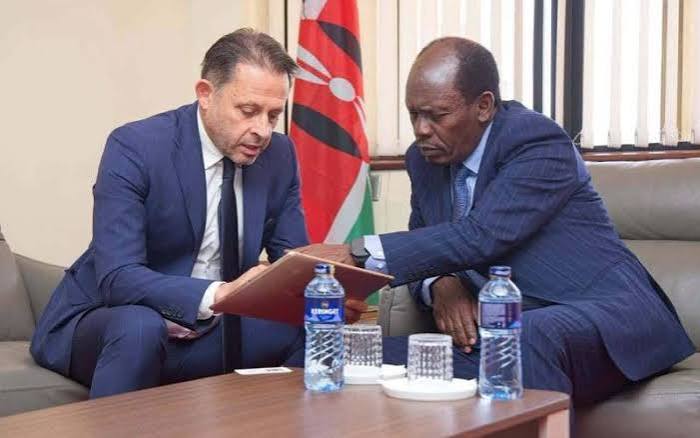
The Kenyan ICT minister, H.E. Hon. William Kabogo Gitau, EGH, Cabinet Secretary, Ministry of Information, Communications and the Digital Economy with Dr. Theodore E. Thodoropoulos – ICT Tower, Nairobi, Kenya, August 2026
Against that backdrop, AMACO Energy Group has introduced HERCULES™, an integrated infrastructure platform designed around the convergence of power generation, cooling and AI computing. The concept was presented to Kenya’s ICT leadership in August by AMACO Energy Group Founder and CEO Dr. Theodore E. Theodoropoulos. The proposition reflects a broader shift taking place in data-centre development globally: as AI workloads increase electricity consumption and thermal-management requirements, access to power is becoming as strategically important as access to fibre, submarine cables and computing technology.
When the Data Centre Brings Its Own Power. Conventional data-centre development typically begins with the availability of grid infrastructure and then builds computing and cooling systems around it. HERCULES™ approaches the problem from the opposite direction. The platform is designed to integrate power-cooling-AI compute within a single infrastructure unit, allowing generation capacity, energy management, thermal infrastructure and high-density computing to be planned as one development rather than as separate engineering projects. The model is intended to support scalable AI factories and next-generation data centres while reducing dependence on incremental grid capacity.
It also introduces a potentially different licensing and development proposition: one integrated development, one operational architecture and a dedicated infrastructure framework. Whether such an approach can ultimately be incorporated into Kenya’s regulatory structure remains a matter for the relevant authorities and stakeholders.
Mombasa Emerges as a Strategic Test Case. The choice of Mombasa looks significant. Kenya’s coastal city is already an important international digital gateway, supported by submarine cable infrastructure, telecommunications connectivity, port facilities and logistics networks. Those characteristics give the wider Mombasa ecosystem several of the ingredients required for large-scale digital infrastructure. AMACO seems that has identified potential sites and configurations within the broader Mombasa ecosystem, including offshore, semi-offshore and onshore development possibilities.
The company is also examining opportunities within the region’s industrial and Special Economic Zone environment. The underlying proposition is to combine digital connectivity with dedicated energy infrastructure, potentially allowing a large-scale AI and data-centre development to operate with substantially greater control over its power supply. Based on the reported news, the company is currently in discussions concerning a 500-acre industrial-park development in Mombasa, with a proposed 175 MW electricity supply from a HERCULES™ unit for digital and industrial applications. If developed, the configuration could create a shared energy ecosystem serving both data-centre, industrial users, mining heavy deployments, and commercial activities.
That would represent a different model from a conventional hyperscale data-centre campus, where power infrastructure is primarily designed around the computing facility itself. It could instead establish a platform in which energy generation becomes a broader component of regional industrial and digital development. The concept is particularly relevant to Kenya, where access to reliable and scalable electricity remains a key consideration for energy-intensive digital infrastructure.

A Strategic Relationship With GE Vernova. AMACO’s HERCULES™ development is also linked to a strategic agreement with GE Vernova concerning power-generation equipment and energy infrastructure across Africa. The relationship brings a major global energy-technology company into the wider infrastructure strategy and highlights the increasing convergence between the power and data-centre industries.
The economics of AI are making that convergence difficult to ignore. Training and operating increasingly sophisticated AI models requires enormous computing capacity. That computing capacity requires electricity. The electricity produces heat. The heat requires cooling. And the entire system must operate continuously. The result is an infrastructure equation in which power availability, cooling capacity and computing density are becoming inseparable.
Kenya Opens a New Regulatory Chapter. The regulatory environment is evolving alongside the technology. The Communications Authority of Kenya’s proposal to establish a dedicated data-centre licence reflects the growing importance of data centres within the country’s digital economy. The proposed framework would cover companies providing colocation data-centre services and related supporting services, distinguishing those operations from the wider network-facilities activities covered by the existing licensing regime. The Authority has opened the proposal to public consultation, allowing operators, investors, technology companies and other stakeholders to submit comments within the prescribed consultation period.
The development comes as Kenya seeks to strengthen its position as a regional hub for cloud computing, artificial intelligence and other data-intensive technologies. For infrastructure developers, the significance extends beyond licensing. A clearer regulatory framework could provide greater visibility for investors considering large-scale digital infrastructure projects, while also establishing specific requirements for an industry whose electricity, cooling, connectivity and physical-security requirements are becoming increasingly complex.
Power Has Become the Strategic Constraint. The challenge is not theoretical.
Data centres already support Kenya’s financial technology, telecommunications, e-commerce, cloud-computing and enterprise-software industries. The expansion of AI is expected to intensify demand for high-density computing infrastructure. Industry assessments have identified reliable electricity supply as one of the critical constraints facing the country’s data-centre market.
The issue has also emerged in connection with major proposed digital infrastructure investments. The planned $1 billion data-centre campus in Kenya announced by Microsoft and G42 in 2024, for example, was conceived around renewable geothermal power and a new East Africa cloud region. The project illustrates both the scale of investment entering the market and the importance of securing an energy source capable of supporting long-term expansion.
The broader lesson is becoming increasingly apparent: Africa’s AI ambitions require an energy strategy as much as a technology strategy. Could HERCULES™ Become a New African Infrastructure Model?
That is the larger question surrounding AMACO’s proposal. HERCULES™ is not simply a proposal for another data centre. Its architecture attempts to combine the infrastructure layers that normally exist independently—generation, cooling and computing—into a single development model. For Kenya, such a model could potentially provide an alternative route to expanding digital infrastructure without relying exclusively on additional national-grid capacity.
For Mombasa, it could provide another dimension to the city’s existing role as an international telecommunications gateway. And for Africa more broadly, the concept arrives at a moment when governments and investors are searching for ways to reconcile rapidly growing AI demand with the continent’s infrastructure limitations.
The potential economic implications extend beyond computing. Large-scale digital-energy developments can create demand for engineering, construction, telecommunications, financial services, technical skills and specialized employment. They can also support the development of local technology ecosystems and increase access to advanced digital services. The HERCULES™ proposition therefore sits at the intersection of three rapidly developing sectors: energy, artificial intelligence and digital infrastructure. Its ultimate significance will depend on execution, financing, regulatory approvals, power economics and the ability to secure suitable sites and connectivity.
In addition, members of Kenya’s engineering community have highlighted HERCULES™ as an emerging generation of scalable, adaptive and potentially mobile Smart Power infrastructure for the AI data-centre ecosystem. According to the technical proposition presented for the platform, a single HERCULES™ unit can be configured from approximately 250 MW to as much as 675 MW of net installed capacity with relatively minor modifications, while maintaining the same core development footprint and without requiring additional seabed or land area, where site conditions permit.
But the timing is notable. As Kenya considers giving data centres their own regulatory identity, a new generation of infrastructure developers is simultaneously asking whether the data centre itself should be redesigned around the power required to operate it. In Mombasa, that question is beginning to take a particularly concrete form. The emerging model is straightforward: build the power, build the cooling and build the compute—together.
Africa stands at a critical juncture in its technological and energy development. While the continent offers significant opportunities for innovation and investment, outdated or fragmented regulatory frameworks can create barriers to the deployment of emerging technologies and integrated sollutions as this one proposed by AMACO Energy Group.
Sources: ICT, CA, THE KENYA WALL STREET, THE DAILY NEWS, DAILY AFRICA, THE STANDARD NEWS, THE TECH CAPITAL, BBC, IW.ICT