

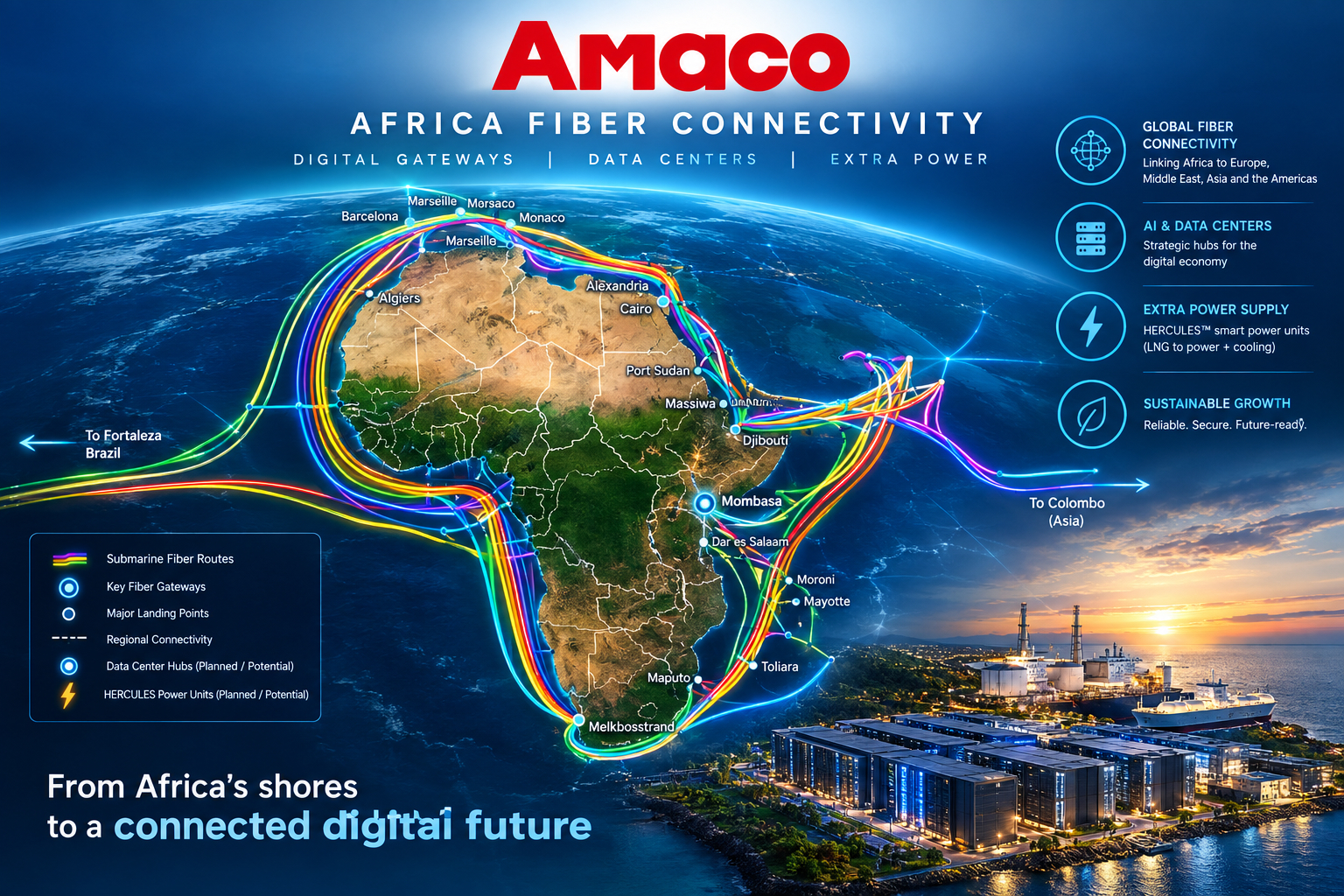
Photo shared by AMACO, as part of HERCULES Unit Fiber Map for Smart Power Delpoyemnt.
Mombasa, Kenya — September 2026
Africa is entering a new phase of digital infrastructure development. Across the continent, submarine fiber systems and terrestrial networks are creating increasingly important connections between Africa and the global digital economy. But connectivity is only one part of the infrastructure equation.
The next challenge is power.
The map illustrates the scale of Africa’s international fiber connectivity, with multiple submarine routes linking the continent to Europe, the Middle East, Asia and the Americas. These networks provide the foundation for cloud computing, artificial intelligence, digital services, financial technology and data-intensive industries.
Yet as data-centre capacity expands, the availability of reliable, scalable and strategically located electricity is becoming increasingly important. The African Actors of Data Center Association reported in 2026 that power availability had overtaken connectivity as the principal constraint for data-centre development in Africa.
From fiber connectivity to digital infrastructure
For years, the development of digital infrastructure has focused heavily on bringing high-capacity fiber to African markets. That investment remains fundamental. However, modern data centres — particularly facilities designed for AI and high-performance computing — require continuous electricity as well as advanced cooling and resilient infrastructure.
This creates a new infrastructure model:
Fiber + Data Centres + Smart Power.
The objective is not simply to connect Africa to the world, but to create the physical infrastructure capable of processing, storing and powering the digital economy within Africa.
Mombasa: a strategic East African gateway
Within this evolving landscape, Mombasa, Kenya has particular relevance.
Mombasa sits at the intersection of international submarine connectivity, Kenya’s national fiber network, the Port of Mombasa and growing regional digital infrastructure. Recent developments include additional fiber connectivity around the Mombasa metropolitan area, linking cable landing stations and data centres and strengthening the city’s interconnection infrastructure.
The city’s significance also extends beyond Kenya. Submarine connectivity landing at the Kenyan coast feeds terrestrial networks serving markets across East Africa, including Uganda, Rwanda, Burundi and Tanzania.
This gives Mombasa a potentially important role in the development of a broader East African digital corridor.
The next infrastructure question: where does the power come from?
As data centres become larger and more energy-intensive, proximity to fiber alone may not be sufficient.
A modern AI data centre needs dependable power at the required scale, together with cooling, transmission or dedicated generation, redundancy and long-term energy arrangements.
This is where smart power generation becomes an important component of digital infrastructure.
Rather than treating the data centre and its electricity supply as completely separate systems, emerging models seek to integrate generation, cooling and computing infrastructure into a coordinated architecture.
The concept is particularly relevant to locations where international connectivity is already strong but additional large-scale power infrastructure is required.
Africa’s opportunity
Africa remains a relatively small share of global data-centre capacity, while demand for cloud services, digital payments, AI, content delivery and local data processing continues to develop. The African data-centre industry therefore has significant infrastructure requirements ahead.
The opportunity extends beyond individual facilities.
Developing digital and energy corridors could support new industrial activity around fiber landing points, ports, special economic zones and major cities. Mombasa is one example of this convergence: international cables arrive at the coast, terrestrial networks carry connectivity inland, and the port and surrounding economic zones provide a platform for additional industrial and digital development.
Recent reporting has also highlighted Mombasa’s growing role in Kenya’s technology ecosystem and the potential for large-scale data-centre infrastructure to develop alongside dedicated power solutions.
Connectivity needs power
The lesson illustrated by the map is straightforward:
Africa’s digital transformation does not end with fiber connectivity.
The next generation of infrastructure will increasingly require the integration of:
FIBER → DATA CENTERS → POWER → COOLING → AI COMPUTE
For East Africa, and particularly for Kenya’s coastal gateway at Mombasa, this combination could form part of a wider infrastructure ecosystem connecting Africa’s digital economy to global markets.
The future infrastructure map of Africa may therefore be defined not only by where the fiber cables land, but also by where reliable power, computing capacity and connectivity come together.
That is the emerging infrastructure opportunity: connecting Africa to the world — and providing the power to process what comes next.