

Artificial intelligence could kill the entire human species, according to people in the artificial intelligence industry. Specifically, they say, it could exterminate humanity within the decade.
Politicians, major news organizations, and Sheryl Crow reacted with alarm last week after an Anthropic employee named Jacob Coxon announced he was quitting the AI company because its work was too dangerous. Evan Hubinger, another Anthropic worker, chimed in to put the chance of AI-powered human extinction within 10 years at greater than 10%.
“It really is about literally everyone on the planet dying, like the last human drawing the last breath,” said Nate Soares, the president of the Machine Intelligence Research Institute (MIRI) and the coauthor of “If Anyone Builds It, Everyone Dies: Why Superhuman AI Would Kill Us All.”
The numbers being attached to that outcome sounded precise. But how, exactly, would computer software, even the world’s most powerful software systems, kill 8.3 billion flesh-and-blood people in a decade?
Not everyone in the AI community subscribes to the doomsday story, in part because the details of the prediction are so sparse. When Elon Musk says SpaceX aims to put people on Mars in “5 to 7 years,” there are clear follow-up questions: Does SpaceX have a working vehicle that would go to Mars? (No.) Does it have a Mars lander or Mars bases? (No.)
“Scientific claims require falsifiability precisely to avoid the nature of religious arguments,” said Heidy Khlaaf, chief AI scientist at the AI Now Institute and a former OpenAI safety engineer. “You need to be able to prove or disprove them.”
Wiped out by synthetic plague?
One line of speculation among the doomsayers is that a sufficiently powerful AI system could use bioweapons to wipe out humanity. But how would AI advance from computer-on-computer misdeeds like hacking into other systems to the physical-world task of breeding and spreading a super pathogen?
homas Larsen, a researcher at the AI Futures Project and former MIRI employee, said that it’s conceivable that a “superintelligent” AI system could convince a human to help it develop a deadly virus.
“There are already a lot of humans talking to their AIs about exactly what experiments they should run in a lab,” Larsen said, referring to a recent report by Anthropic about researchers using Claude to help them with viral and toxin research. “It’s very easy for me to imagine an AI that’s just currently deployed — if it was much smarter and more strategic and wanted to do this — just like tricking a human into building it and releasing it.”
Soares suggested that, rather than needing a human patsy, a self-improving AI program might “just start synthesizing their own life forms in an autonomous biological laboratory.”
Slaughtered by robots?
What about killer robots? Soares sees Elon Musk’s desire to build an army of autonomous, self-replicating bots as a potential weak point in human survival. “Once you’ve created these robots that can make the energy infrastructure and make the factories that can that can make more robots, that is in some sense a new mechanical life form,” he said. “At some point you silently cross the point of no return. Where if the humans say they want to turn the AI off, the AIs can say, ‘Actually, we decided we want to turn the humans off.’ You have to stop before then.”
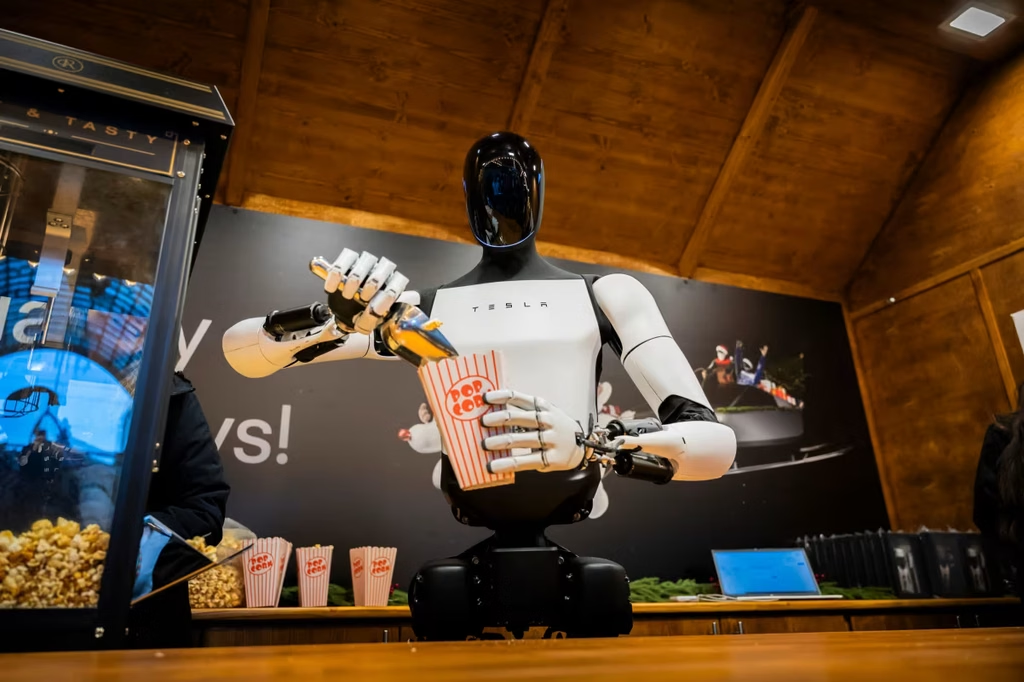
So far, however, Musk has repeatedly failed to bring his much-promised Optimus robots to the consumer market on his announced schedule, let alone to deploy them by the millions or get them to start building one another in a self-replicating manufacturing chain.
Or nuked?
Then there are nuclear weapons, which have existed for more than 80 years and are generally understood to be capable of killing off all human life. Could AI commandeer them?
Khlaaf points out that nuclear facilities are “air-gapped” from the publicly accessible internet, which limits the ways AI agents could get at the controls. “These systems are built to a completely different, rigorous and regulated engineering standard that often requires physical hardening,” she said. Stuxnet, the computer worm that damaged Iran’s nuclear facilities, had to be introduced to the system through a physical USB drive, she noted.