

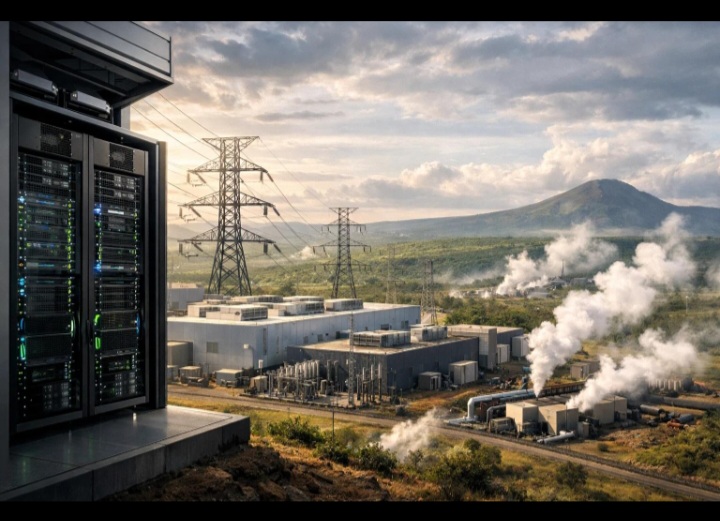
Africa could capture up to $1 trillion in additional economic value from artificial intelligence by 2035, but shortages of electricity, computing capacity and locally available data are emerging as major barriers to the continent’s AI ambitions.
Africa is entering a critical period in the development of its artificial intelligence ecosystem, with the continent facing the opportunity to generate significant economic value from AI while simultaneously confronting major infrastructure constraints.
A new assessment highlighted by the World Bank estimates that artificial intelligence could create up to $1 trillion in additional economic value for Africa by 2035. However, realising that opportunity will depend on the continent’s ability to expand the infrastructure required to develop and deploy AI technologies.
Among the most significant constraints are reliable electricity, computing capacity, data availability and affordable digital connectivity.
Power is becoming a strategic AI issue
The rapid development of AI globally is increasing demand for computing infrastructure, and data centres require substantial quantities of reliable electricity.
For African markets, this creates a particular challenge. Many countries continue to face electricity shortages, limited generation capacity and constrained transmission and distribution networks.
At the same time, individual hyperscale and AI-focused data-centre campuses can require electricity loads that are significant relative to the power systems serving the countries where they are located.
Recent analysis of Africa’s data-centre market highlights this issue, noting that the continent had approximately 360 MW of active data-centre capacity at the beginning of 2026, representing only a small share of global capacity. The challenge is increasingly one of local grid capacity rather than simply Africa’s overall energy resources.
Data-centre investment is accelerating
Despite these constraints, investment in African digital infrastructure continues.
South Africa remains one of the continent’s leading data-centre markets, while Kenya, Nigeria, Egypt and other markets are attracting increasing interest from operators and technology companies.
Recent developments include the expansion of data-centre infrastructure in South Africa and plans for additional capacity in Nigeria.
Kenya is also seeking to strengthen its position as a regional digital infrastructure hub. Recent industry developments include the launch of Digital Realty’s NBO2 data centre in Nairobi, while policymakers have been considering a standalone regulatory framework for data centres.
These developments point to a growing African market for cloud computing, artificial intelligence, telecommunications and digital services.
The infrastructure gap
The expansion of AI infrastructure creates a fundamental question for African economies: where will the power required to run the next generation of computing infrastructure come from?
Africa has significant renewable-energy resources, including solar, wind, hydro and geothermal power. Kenya, for example, has developed substantial geothermal generation capacity, while countries across the continent have large solar and hydroelectric potential.
However, generation capacity alone is not sufficient.
Data centres require reliable electricity around the clock, meaning that generation must be supported by transmission networks, distribution infrastructure, storage or other forms of firm and flexible power.
This makes the development of AI infrastructure closely connected to investment in the wider electricity system.
A new opportunity for African power markets
The growth of AI and data centres could also create a new source of demand for Africa’s electricity sector.
Large technology projects can provide long-term electricity demand that may support investment in generation and grid infrastructure, particularly where developers and power producers are able to structure long-term power agreements.
The emerging relationship between data-centre developers and energy companies is therefore becoming increasingly important.
Rather than treating data centres purely as technology projects, investors are increasingly considering power availability, grid capacity, generation technology, cooling and connectivity as part of one infrastructure equation.
Building Africa’s AI infrastructure
For African countries seeking to attract AI investment, the challenge will be to build an ecosystem capable of supporting both computing and electricity demand.
That means expanding generation capacity while improving transmission and distribution networks, developing data-centre facilities, strengthening fibre connectivity and creating the regulatory conditions needed to attract long-term investment.
The continent’s AI opportunity will ultimately depend not only on access to advanced models and software, but also on the physical infrastructure required to operate them.
As AI becomes increasingly electricity-intensive, power infrastructure is emerging as one of the foundations of Africa’s digital economy.
The countries able to combine reliable electricity, high-quality connectivity, computing capacity and investment-friendly policies could be best positioned to capture a larger share of the economic value generated by the next phase of artificial intelligence.