

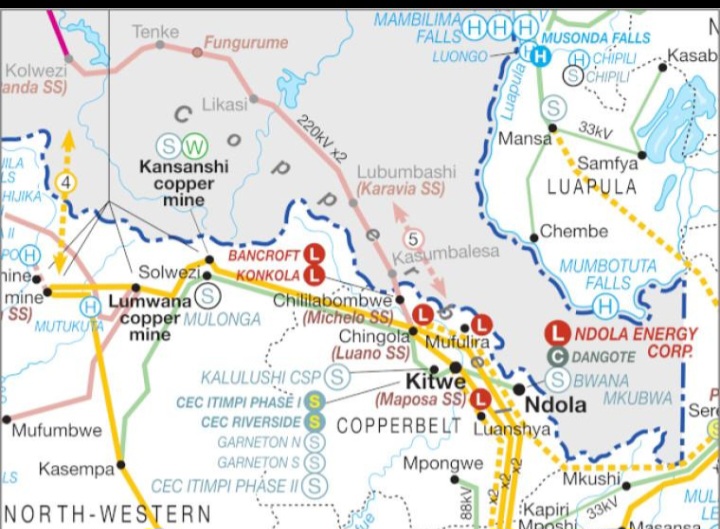
A planned 700 MW transmission link between Zambia and the Democratic Republic of Congo could strengthen regional electricity trading, supply power to the Copperbelt mining region and create new export opportunities for electricity producers.
A new chapter for regional electricity infrastructure
Zambia and the Democratic Republic of Congo (DRC) are advancing a major cross-border electricity project aimed at improving power supply to one of Central Africa’s most important mining regions.
On 6 October 2026, the DRC’s Strategic Investment Fund (FIS-RDC), Congolese power trader EnPower, global commodities group Trafigura and infrastructure investor Gridworks signed a strategic framework agreement to finance, build and operate the Kalumbila–Kolwezi Interconnector Project.
The planned 200-kilometre high-voltage transmission line will connect Kalumbila in Zambia with Kolwezi in the DRC, strengthening the flow of electricity between the two countries.
The project has an estimated construction cost of $300 million and a planned thermal transmission capacity of 700 MW. Its design would enable the import of up to 550 MW of competitively priced electricity into the DRC’s Copperbelt mining region, with potential for future expansion beyond 1 GW.
The agreement represents an important step towards developing the infrastructure needed to connect regional electricity resources with industrial demand. However, the project remains at the development and financing stage; the agreement is not confirmation that construction has been completed.
Why the Copperbelt needs more power
The Copperbelt is a major centre for copper and other mineral production, with mining and processing operations requiring substantial and dependable electricity supplies.
Copper is essential to electrical wiring, power transmission, renewable energy technologies, electric vehicles and other industrial applications. As demand for electrification and energy infrastructure grows, securing reliable electricity has become increasingly important for mineral-producing economies.
Power shortages can constrain production, delay the development of new mines and processing facilities, and increase operating costs where companies must rely on alternative sources of electricity.
According to the project partners, the DRC faces a structural electricity deficit exceeding 1 GW. The proposed interconnector is intended to help address this shortfall by enabling additional electricity to reach the Copperbelt from the wider Southern African power market.
Improved access to competitively priced power could support existing mining operations and help advance projects that have faced electricity supply constraints.
The potential benefits extend beyond mining. More dependable electricity can support mineral processing, industrial services, logistics and businesses operating in communities around major production centres.
The actual impact will depend on the electricity available for import, commercial supply arrangements, transmission charges and the ability of the network to deliver power reliably.
How Zambia could benefit
The interconnector is designed to create opportunities for electricity producers and licensed power traders in Zambia to supply customers across the border.
Cross-border transmission infrastructure can help connect electricity demand in one country with generation capacity available in another. This can create additional markets for power producers and improve the use of existing generation assets.
For Zambia, the project could provide an additional route for electricity exports while creating opportunities for investment in future generation capacity.
It could also strengthen the commercial relationship between the two countries by linking their electricity markets more closely.
However, the availability of export power will remain critical. Zambia must balance any cross-border sales against domestic electricity requirements and the reliability of its own supply system.
The project’s long-term success will therefore depend on coordinated planning, credible power purchase arrangements and effective management of transmission capacity.
The Southern African Power Pool connection
The Kalumbila–Kolwezi Interconnector is intended to strengthen the DRC’s connection to the Southern African Power Pool (SAPP), which facilitates electricity trading and cooperation among participating power systems in the region.
Regional electricity trading can provide countries with access to a wider range of power sources instead of relying exclusively on domestic generation.
It can also create opportunities to use available generation more efficiently, subject to transmission capacity, market rules and the electricity needs of participating countries.
For countries with growing industrial demand, stronger interconnections can form part of a broader strategy to improve energy security.
Nevertheless, transmission lines alone cannot eliminate power shortages. Adequate generation, well-maintained networks, operational coordination and financially sustainable electricity markets remain essential.
The proposed project is therefore one component of a wider regional infrastructure challenge: ensuring that electricity can be generated, transmitted and delivered where it is needed.
A financing partnership bringing together public and private capital
The agreement brings together a public investment institution, a Congolese power developer and international infrastructure and commodities companies.
FIS-RDC, the DRC’s Strategic Investment Fund, has confirmed its intention to invest equity in the project. The transaction is its first announced investment since the fund was established in October 2025.
EnPower is the project developer and a licensed Congolese power trader. Gridworks Development Partners, which specialises in electricity transmission and distribution infrastructure in Africa, is the lead equity investor and intended majority shareholder.
Trafigura has agreed to arrange a significant share of the project’s debt financing.
The partners are also discussing potential participation by Zambian entities, which could widen local involvement in the project.
This financing structure combines several capabilities: project development, equity investment, debt arrangement and expertise in regional energy markets.
Such partnerships can be important for capital-intensive infrastructure, where funding needs are substantial and returns depend on the project operating over many years.
The financing plan must still translate into a bankable project with clear revenue arrangements, manageable construction risks and reliable electricity offtake.
What the project could mean for African industrialisation
The interconnector highlights the relationship between electricity infrastructure and the development of higher-value industrial activity.
Countries that produce minerals do not automatically capture the full economic value of those resources. Processing, refining and manufacturing require reliable power, transport networks, technical skills and access to markets.
By helping address electricity constraints in the Copperbelt, the project could support further investment in mineral processing and related industries.
It could also strengthen the case for regional approaches to infrastructure development, in which countries coordinate electricity supply and demand rather than treating national power systems as entirely separate markets.
For investors, the project demonstrates the commercial importance of transmission infrastructure in unlocking industrial opportunities. For governments, it illustrates how regional cooperation can help address energy constraints that affect production and economic growth.
The benefits will depend on whether improved power availability translates into increased output, new investment, jobs and wider economic participation.
Beyond mining: the importance of reliable power
Although the project is anchored by demand from the mining industry, the project partners indicate that the transmission line could also provide capacity to serve the wider population.
This is significant because reliable electricity is essential for businesses, public services, telecommunications and digital infrastructure.
As African economies expand their use of cloud computing, artificial intelligence and data centres, the availability and cost of electricity will increasingly influence where new digital infrastructure is developed.
Transmission capacity can help bring power to industrial and commercial demand centres, but it does not automatically guarantee electricity access for households or individual businesses. Distribution networks, generation availability, tariffs and national electricity policies remain important.
The broader lesson is that power infrastructure needs to be planned around both productive industries and the long-term electricity requirements of communities.
What happens next?
The strategic framework agreement establishes a basis for the project partners to work towards financing, construction and operation of the Kalumbila–Kolwezi Interconnector.
The next milestones will include progressing the investment and financing arrangements, finalising commercial agreements and preparing for construction and eventual commissioning.
The partners will also need to coordinate with relevant authorities and electricity market participants in both countries to ensure that the project can operate effectively within regional power-trading arrangements.
If delivered as planned, the interconnector could strengthen electricity links between Zambia and the DRC, support industrial development in the Copperbelt and create additional opportunities for regional power trading.
Its significance extends beyond the planned transmission line itself. It demonstrates how cross-border infrastructure can help connect energy resources with industrial demand, while creating a platform for further investment in Southern Africa’s electricity networks.
For Africa, the challenge is to turn such agreements into operating infrastructure that delivers reliable power, supports competitive industries and generates tangible economic benefits.