

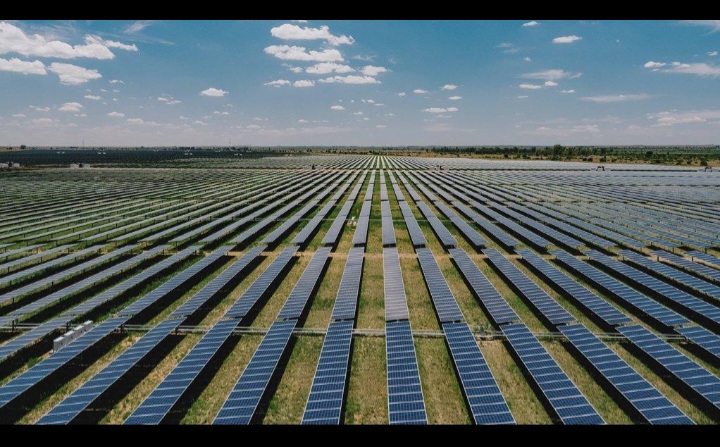
The Lion Thorn Solar Park will supply renewable electricity to businesses through the national grid, highlighting the growing role of private power producers and corporate power purchase agreements in Africa’s evolving electricity markets.
Construction begins on a new industrial power project
South Africa’s renewable energy sector has reached another milestone with the start of construction on the 49 MWp Lion Thorn Solar Park in the North West province.
Yellow Door Energy, the project developer, broke ground on the facility near Leeudoringstad in the Maquassi Hills Local Municipality on 12 October 2026. The project has moved from financial close into construction, with commercial operations expected to begin in 2028.
The development is designed to supply renewable electricity to commercial and industrial customers through electricity-wheeling arrangements. This allows power generated at one location to be delivered to customers elsewhere through the existing electricity network, subject to applicable grid and market arrangements.
The project has secured power purchase agreements (PPAs) with PPC, a South African cement and construction materials producer, and POWERX, a licensed electricity trader.
PowerChina has been appointed as the engineering, procurement and construction contractor, while Nedbank Corporate and Investment Banking provided project financing.
The development illustrates how private investment is helping expand renewable generation while creating alternative procurement options for businesses seeking reliable and competitively priced electricity.
What the project will deliver
Lion Thorn Solar Park is expected to generate approximately 115 gigawatt-hours (GWh) of renewable electricity in its first year of operation.
The developer also estimates that the project could avoid approximately 104,190 tonnes of carbon emissions annually.
These figures are projections rather than measured operating results. Actual generation and emissions savings will depend on the plant’s performance, grid conditions and the electricity sources it displaces.
The project’s 49 MWp capacity refers to the peak output rating of its solar photovoltaic panels. Actual electricity production varies with sunlight, weather, equipment performance and operating conditions.
Once operational, the facility will add new renewable generation to South Africa’s electricity system and supply customers through contracted commercial arrangements.
Its construction is also expected to create employment and procurement opportunities in Maquassi Hills and surrounding communities, with an emphasis on local workers, contractors and suppliers. The scale of these benefits will depend on implementation and the extent of local participation.
Why electricity wheeling matters
Traditional electricity arrangements often involve customers purchasing power directly from their local utility. Electricity wheeling creates another option by enabling electricity produced by an independent generator to be transported through an existing network to a separate customer.
Under this model, a company does not necessarily need to build a solar farm on its own premises to purchase renewable electricity.
Instead, it can enter into a power purchase agreement with a generator or trader, with the relevant network and commercial arrangements governing how the electricity is delivered and settled.
For large industrial consumers, this model can provide access to renewable energy resources that may be unavailable at their own sites. It can also allow independent power producers to develop projects in locations with suitable solar resources and connect their output to customers elsewhere.
However, wheeling does not mean that electricity is physically routed exclusively from one specific solar plant to one particular customer. Electricity flows through the interconnected network, while contractual and settlement arrangements account for the generation and consumption.The model also depends on adequate grid capacity, network charges, licensing arrangements and the ability to manage differences between electricity generation and customer demand.
Industrial customers are reshaping electricity demand
PPC’s participation highlights the importance of electricity procurement for energy-intensive industries.
Cement manufacturing requires substantial energy for machinery, grinding and other industrial processes. Electricity prices, supply reliability and emissions performance can therefore influence operating costs and investment decisions.
By securing renewable electricity through a PPA, industrial customers can diversify their power procurement arrangements and potentially reduce exposure to some conventional electricity costs.
Long-term agreements can also provide renewable developers with contracted demand, which may help them secure financing and proceed with construction.
POWERX’s role as an electricity trader creates another route for the project’s output to reach eligible customers through the wheeling market.
This combination of generation, contracted industrial demand, electricity trading and bank financing illustrates how different market participants can work together to bring new capacity online.
The economic benefits will ultimately depend on the terms of the agreements, the project’s operating performance and the electricity costs faced by participating customers.
Private investment is changing South Africa’s power market
Lion Thorn is part of a wider shift towards greater participation by independent power producers and private electricity traders in South Africa.
Businesses are increasingly exploring alternatives to relying solely on conventional utility supply, including private renewable generation, PPAs, wheeling and on-site energy systems.
This does not eliminate the need for public electricity infrastructure. New private generation still depends on transmission and distribution networks, system balancing and appropriate market rules.
The national grid remains essential for transporting electricity and supporting the wider electricity system. As more independent projects connect, network investment and effective coordination become increasingly important.
South Africa’s experience offers a relevant case study for other African markets seeking to attract private capital into power generation while meeting the needs of commercial and industrial consumers.
The financing and construction challenge
Although the project has reached financial close and construction has begun, delivery remains the next critical milestone.
PowerChina’s appointment as EPC contractor places responsibility for engineering, procurement and construction within an established project-delivery structure.
Nedbank’s financing support also demonstrates the role commercial and investment banks can play in enabling renewable projects to progress beyond development. Nevertheless, solar projects must still manage construction schedules, equipment procurement, grid connections and commissioning requirements.
The plant will need to demonstrate that it can achieve its expected generation levels and meet the commercial obligations established under its PPAs. For the wider industry, the project reinforces the importance of bankable offtake agreements, credible developers, suitable financing structures and predictable regulatory arrangements.
What this means for Africa’s energy sector
Across Africa, industrialisation and economic growth depend on electricity that is dependable, affordable and available where businesses need it.
Private renewable energy projects can contribute additional generation capacity and offer businesses more flexibility in how they source power. Yet the opportunities vary between countries, depending on market regulation, grid access, renewable resources and the financial strength of electricity buyers.
South Africa’s wheeling model shows one way to connect privately developed renewable generation with customers that may be located far from the generating facility.
For other African economies considering similar arrangements, the key questions include how electricity wheeling is regulated, who pays for network use, how transactions are settled and how grid reliability is maintained. The broader lesson is that energy investment requires coordination across generation, transmission, financing and commercial demand.
Looking ahead to 2028
With construction underway, Lion Thorn Solar Park is expected to begin commercial operations in 2028.
The next milestones will include completing construction, securing the required grid connection and commissioning the facility before it begins supplying electricity under its commercial arrangements.
If delivered as planned, the project will add nearly 50 MWp of solar capacity and strengthen the role of private electricity procurement in South Africa.
Its wider significance lies in the model it represents: a privately financed renewable energy project developed around contracted business demand and connected to customers through the existing grid.
For PowerTech Africa readers, the development offers a timely example of how new power infrastructure can be financed, built and integrated into a changing African electricity market.