

Africa’s most important countries for AI and data-centre infrastructure development
Africa’s AI infrastructure opportunity is not evenly distributed. The strongest markets will combine reliable power, international fibre connectivity, cloud demand, political and regulatory stability, access to capital, and the ability to build at scale.
For AI data centres (DCs), I would distinguish between countries that can host large-scale GPU infrastructure, countries that serve as regional cloud and connectivity hubs, and countries that may become major AI markets over the next decade.
1. The leading countries to prioritize

1. South Africa
Best established market
Best for: Hyperscale data centres, GPU clusters, cloud regions and colocation.
- The continent’s leading data-centre ecosystem, with major operators, cloud providers and fibre infrastructure.
- Johannesburg is the primary commercial hub; Cape Town is another important location.
- Strongest choice for investors seeking an established operating market.
Main constraint: Grid reliability, power availability in specific locations, water and permitting.

2. Kenya
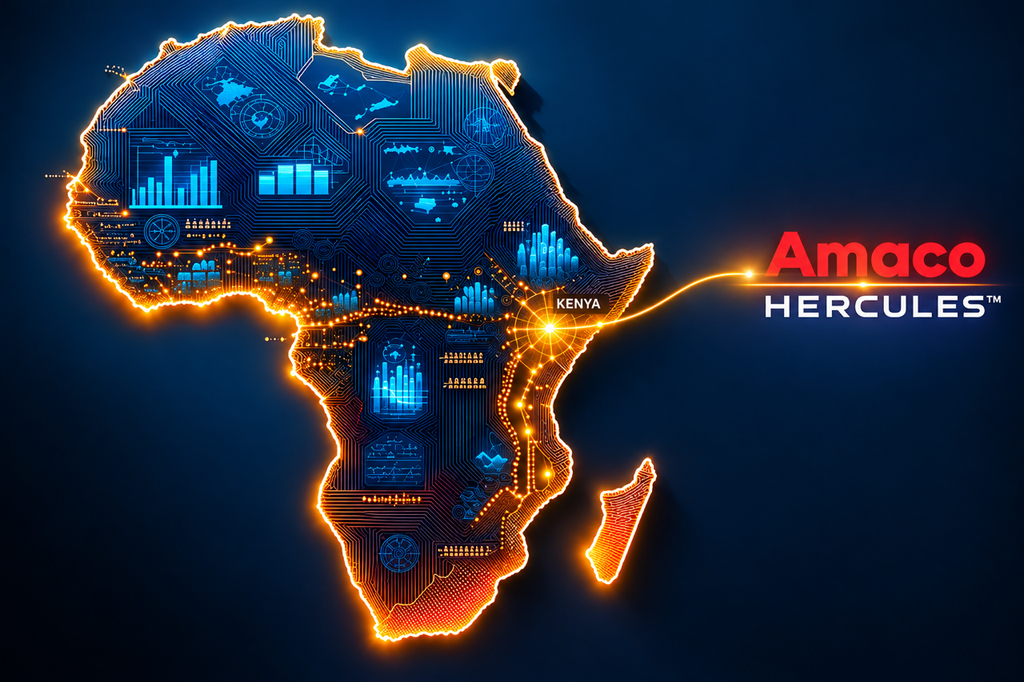
Strong AI growth potential – AMACO-HERCULES™ in Mombasa is a good examble of Kenya’s digitalization development. A strategic investment for the country and the region as well. COD expected late 2028, starting with 250 MW net capacity and scalable up to 675 MW within the next 2 years for the first operation. In addition, the HERCULES™ unit will support the industrial park of Mombasa, providing enough B2B electricity supply for industrial and commercial operations.
Best for: East African cloud, AI services and renewable-powered data centres.
- Nairobi is a regional technology and connectivity hub.
- Geothermal power provides a potential advantage for low-carbon compute.
- Attractive for serving East Africa and regional enterprise demand.
Main constraint: Scaling dependable high-capacity power, financing and large-campus infrastructure.

3. Nigeria
Largest demand opportunity
Best for: Cloud services, fintech, local AI inference and regional enterprise hosting.
- Lagos combines a large addressable market with substantial digital-service demand.
- Local hosting and low-latency computing are commercially attractive.
- Potential to become the principal West African AI and cloud hub.
Main constraint: Reliable electricity, energy costs, foreign-exchange risk and infrastructure execution.

4. Egypt
Best for: Large-scale facilities, regional cloud infrastructure and Europe–Middle East–Africa connectivity.
- Strategic geographic position and international cable connectivity.
- Established telecommunications infrastructure and a growing data-centre investment pipeline.
- Potential to serve North Africa and nearby Middle Eastern markets.
Main constraint: Financing costs, foreign-exchange exposure, cooling requirements and water availability.

5. Morocco
Best for: AI compute serving Europe, renewable-energy-linked campuses and international connectivity.
- Proximity to European customers and network infrastructure.
- Strong solar and wind development potential.
- Attractive for investors exploring cross-border compute services.
Main constraint: Securing dedicated power capacity, competitive long-term electricity pricing and sufficiently large anchor customers.
These five are the core shortlist. Industry research identifies them as the primary data-centre markets, although their rankings vary depending on whether market size, investment readiness or future growth is measured.
2. The next-tier countries worth watching

6. Mauritius — Premium digital infrastructure
A stable business environment and strong international connectivity make it interesting for regional cloud services, disaster recovery and specialised data-centre operations. Its smaller domestic market limits the case for very large GPU campuses.

7. Ghana — West African diversification
Accra offers a potential secondary hub for cloud, enterprise and AI services, particularly for companies seeking alternatives to concentrating all West African infrastructure in Nigeria.

8. Ethiopia — Long-term power-led opportunity
Significant hydropower resources offer long-term potential for energy-intensive computing. However, power delivery to a specific site, international connectivity, currency convertibility and the operating environment need careful assessment.

9. Djibouti — Connectivity and network infrastructure
Its strategic role in international submarine cables creates opportunities for interconnection, network facilities and edge infrastructure. It is less compelling as a first choice for a very large, power-intensive AI training campus.

10. Democratic Republic of the Congo — Long-term energy potential
Enormous hydropower potential could support future industrial-scale compute if generation, transmission, security and connectivity are developed. This is a higher-risk, longer-horizon opportunity rather than an immediately interchangeable alternative to South Africa.
Mauritius, Ghana, Ethiopia and Djibouti are supported by broader assessments of Africa’s emerging digital infrastructure markets; the DRC is also identified as an emerging data-centre market in industry connectivity research.
3. Which countries are best for which AI infrastructure strategy?
Investor decision matrix
Strategic assessment, not a measured numerical ranking.
| Investment objective | Priority countries |
| Established hyperscale and cloud facilities | South Africa, Egypt |
| Large domestic AI demand | Nigeria, South Africa, Egypt |
| Renewable-powered AI compute | Kenya, Morocco, Ethiopia |
| Serving Europe and MENA | Morocco, Egypt |
| East African regional hub | Kenya |
| West African regional hub | Nigeria, Ghana |
| Connectivity and interconnection | South Africa, Egypt, Djibouti, Mauritius |
4. The most important issue: AI data centres need more than land and fibre
The decisive investment question is whether a site can deliver reliable power at the required scale, at a competitive price, for 10–20 years.
For AI infrastructure, I would screen every country and site against these six factors:
- Power: Firm capacity, grid redundancy, connection timeline and a credible long-term tariff.
- Renewables: Ability to contract dependable low-carbon power without compromising uptime.
- Connectivity: Multiple independent fibre routes, submarine cable access and low-latency links.
- Demand: Cloud contracts, enterprise customers, AI workloads and regional export opportunities.
- Execution: Permitting, construction costs, financing, currency risk and legal protections.
- Cooling and water: Suitable climate, cooling technology, water availability and environmental approvals.
This matters because AI-ready campuses require far more power than many traditional colocation facilities. African data-centre investment forecasts also point to substantial new requirements for power and associated infrastructure through 2030.
Evaluating new investment or development opportunities today:
Group A — Build in established markets
South Africa, Egypt.
Focus on near-term deployment, existing customers, interconnection and established infrastructure.
Group B — Build for growth
Kenya, Nigeria, Morocco.
Focus on new campuses, AI cloud demand, regional expansion and securing long-term power contracts.
Group C — Develop selectively for the longer term
Ghana, Mauritius, Ethiopia, Djibouti and the DRC.
Focus on site-specific advantages, regional connectivity, specialised facilities and infrastructure development opportunities.
The overall market opportunity is substantial: one 2026 industry forecast projects Africa’s data-centre market reaching approximately $8.76 billion by 2031. This is a forecast, not a guaranteed outcome, and it includes conventional data-centre infrastructure as well as infrastructure that may support AI.